 12Focus
Weekly focus ideas and how to pick one
A good weekly focus is one result you can check on the last day of the week, like “Send the proposal draft by Friday”, with two or three actions that each have a day. Here are 30 of them for work, study, health and home, and a template to write your own.
Pick one. Everything else gets a day next week, written down, so it stops pulling at you.
Updated
What is a weekly focus?
It answers one question: if only one thing gets done this week, which one makes the week count? Write it as a result, not a mood. “Health week” is a theme; it says nothing about Tuesday. “Three runs: Tuesday, Thursday and Saturday” is a focus.
One focus doesn’t mean one action. It means the focus gets the first slot on its days, and the rest of the week fits around it.
The rest still needs a place. In a series of experiments, Masicampo and Baumeister (2011) found that unfinished goals kept intruding on people’s thoughts while they read something unrelated, and that making a specific plan for them stopped it. So give everything that isn’t this week’s focus a specific day next week, written down.
How do you choose a weekly focus?
Answer three questions, in order. Here they are for one goal, a first job in design, in week 3 of a 12-week plan.
Giving each action a day matters. In a meta-analysis of 94 independent tests, Gollwitzer and Sheeran (2006) found that plans that spell out when, where and how you will act had a medium-to-large effect on reaching goals. Running a Winter Arc? The same three questions turn it into this week.
- Which goal is this week for? Start from the bigger goal, not from the inbox.
- What one result would make it count? Something finished by the week’s last day.
- Which days, and what does done look like? Two or three actions, each with a day.
What is a good weekly focus for work?
A result a colleague could check on Friday. Ten examples, each with the actions that make it happen:
- Send the proposal draft by Friday. Outline Tuesday, draft Wednesday, send Friday at 10:00.
- Answer every client email older than a week. 30 minutes at 9:00 on Monday, Wednesday and Friday.
- Walk into the quarterly review ready. List three wins Monday, pull the numbers Wednesday, rehearse Thursday.
- Get feedback on the pricing page from five customers. Pick them Monday, send the ask Tuesday, sum up the replies Friday.
- Finish the onboarding doc for the new hire. Outline Tuesday, write Wednesday, go through it together Friday.
- Two mornings with no meetings. Move two recurring calls Monday, then keep Tuesday and Thursday 9 to 11 clear.
- Have the deadline conversation. Write your three points Monday, book 20 minutes Tuesday, talk Wednesday.
- Learn enough SQL to pull the weekly report. A lesson Monday and Wednesday, the real query Friday.
- Apply to three jobs with a CV fitted to each. One on Tuesday, Thursday and Saturday.
- Publish one case study for your portfolio. Pick the project Monday, write Wednesday, publish Friday.
What weekly focus works for students?
One piece of coursework or one test, finished early enough to fix what it shows:
- First draft of the history essay, done. Outline Monday, 600 words Tuesday and Wednesday, finish Thursday.
- Know chapters 4 and 5 for the biology test. Flashcards Monday and Wednesday, a practice test Thursday.
- Every problem in this week’s calculus set. Half on Tuesday, the rest Thursday, check answers Friday.
- Read and sum up five papers for the literature review. Two Monday, two Wednesday, one plus notes Friday.
- Catch up on the two lectures you missed. One Tuesday, one Thursday, questions written down for Friday.
- Your part of the group slides, sent. Draft Monday, finish Wednesday, send to the group Thursday.
- Clear feedback on the last essay. Reread it Monday, write two questions Tuesday, office hours Wednesday.
- Learn 60 Spanish words. Twenty on Monday, Wednesday and Friday, a self-test Saturday.
- Send the scholarship application. Personal statement Monday to Wednesday, references Thursday, submit Friday.
- Three phone-free study evenings. Two hours on Monday, Tuesday and Thursday, the phone in another room.
If the phone keeps winning the evening, lock the apps first: on iPhone or on Android.
What about health, money and home?
The same rule: a result with days, not a wish. “Get fit” and “sort out money” never end, so they never feel done.
- Three runs. Tuesday, Thursday and Saturday at 7:00.
- Cook dinner at home three nights. Shop Sunday, cook Monday, Wednesday and Friday.
- A 30-minute walk after lunch, three days. Monday, Wednesday and Friday.
- A budget for this month. List fixed costs Monday, sort last month’s spending Wednesday, set three limits Friday.
- Cancel the subscriptions you don’t use. List them Monday, cancel Wednesday, check the statement Friday.
- Clear the spare room. Sort a box Tuesday and Thursday, drop off what you’re giving away Saturday.
- Call two friends you haven’t seen in a while. One on Wednesday, one on Sunday, a date set with each.
- Book the dentist and the eye test. Find times Monday, book both Tuesday.
- Read 60 pages of one book. Twenty pages on Monday, Wednesday and Friday evening.
- Plan the trip. Dates Monday, budget Wednesday, book the train Friday.
What goes in a weekly focus template?
Five lines. Fill them in here, then copy them into your notes. What you type stays in your browser.
No bigger goal yet? Break one into weeks first, or let the free planner draft all twelve.
What if the week goes sideways?
Keep the focus and shrink the actions. If Thursday breaks, move its action once, to a day with room, or cut it smaller. A focus finished at half size still moves the goal; one dropped on Wednesday doesn’t.
On the last day, count what got done against the plan, write one line on what got in the way, and choose next week’s focus from there. Writing it down helps: in a meta-analysis of 138 studies, Harkin and colleagues (2016) found that monitoring progress helped people reach their goals, and helped more when the progress was written down or reported to others. The ten-minute weekly review walks through it.
Is there an app for a weekly focus?
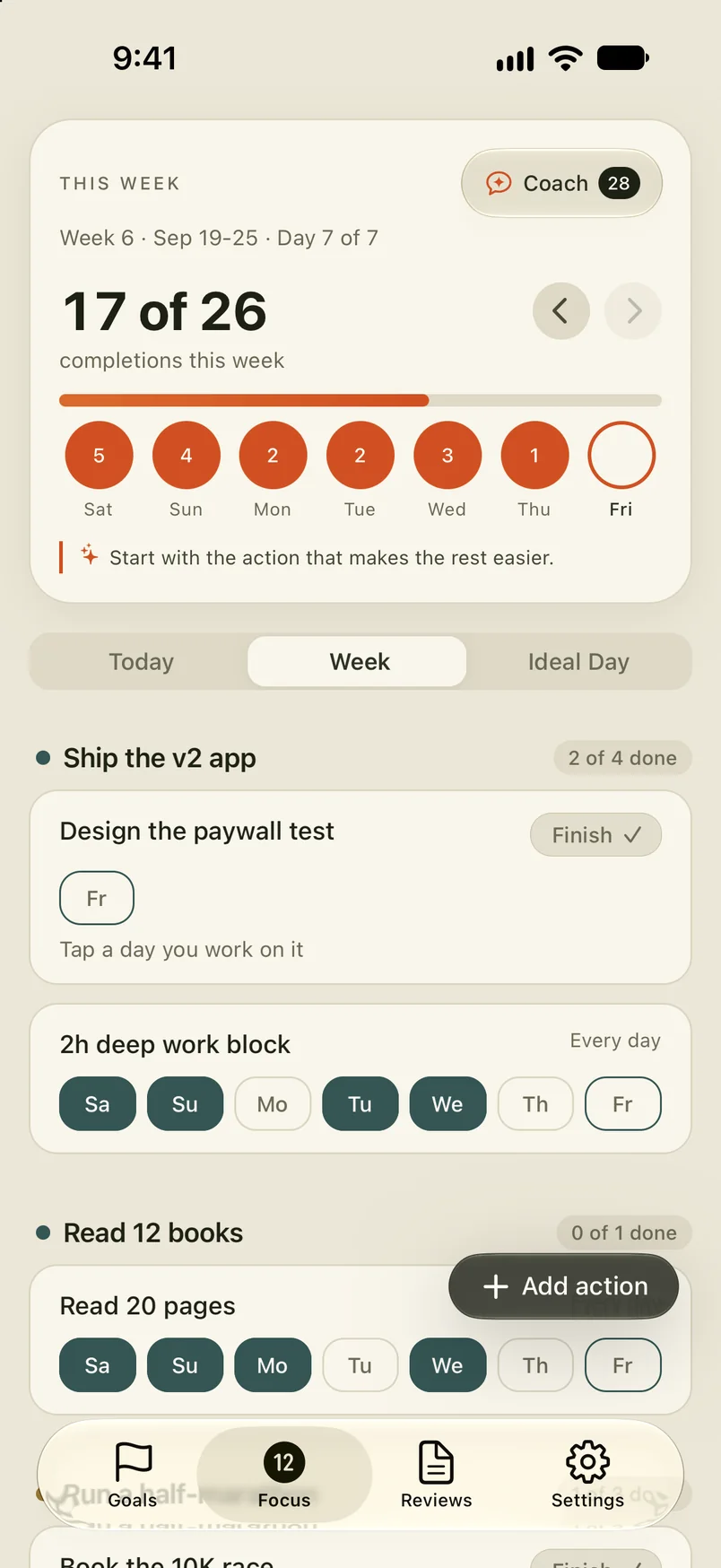
12Focus is built around one. It holds up to three goals for a 12-week cycle, turns each week into a few actions with days, and shows today’s on one screen. The week closes with a short review where you choose next week’s priorities.
On iPhone and Android, you can also give the apps you choose a daily allowance, and each planned action you finish adds minutes. How the 12-week planner works.
What people ask about a weekly focus
What is a weekly focus?
The one result that makes the week count if nothing else gets done, written so you can check it on the last day: “Send the proposal draft by Friday”, not “work on the proposal”.
How many priorities should you have in a week?
One focus, with two or three actions that each have a day. Other goals can get a smaller action or wait; write down which day they get, so they stop pulling at you.
What is the difference between a weekly focus and weekly goals?
A list of weekly goals can hold five things that all look equal. A weekly focus says which one wins when the week gets crowded. You can keep both: one focus, plus a short list of smaller things.
Should a weekly focus be a word or a theme?
A word or a theme (“health”, “calm”) can set the tone, but it doesn’t tell you what to do on Tuesday. Turn it into one result with days: “Three runs: Tuesday, Thursday and Saturday.”
When should I set my weekly focus?
At the end of the week before, right after you look at how it went. Use the same day every week; if you plan in 12-week cycles, use the weekday your cycle started.
What if I don’t finish my weekly focus?
Count what got done, name what got in the way, and choose next week’s focus from there. Keep it at a smaller size, or drop it if it no longer moves the goal. Carrying it over unchanged only makes next week heavier.
Give the week one thing to be about
12Focus holds up to three goals for a 12-week cycle, turns each week into a few actions, and closes it with a short review.