 12Focus
Why you quit goals and how to keep going
Usually not because you stopped caring. More often the plan has one of five gaps: the finish line is too far away, there is no next action, a bad day turns into all or nothing, one missed day becomes a missed week, or nobody else knows the goal exists.
Each of the five has a small fix. For the day you want to give up, there are three lines: name what happened, do the smallest version of today’s action, and decide at the weekly review, not today.
Updated
Why do I keep giving up on my goals?
It rarely feels like a decision. It’s 9 pm, the run didn’t happen again, and a quiet thought arrives: maybe this goal isn’t for me. Often that thought is wrong about you and right about the plan. Here are five common gaps, each with a fix you can make this week.
Sometimes the reason is real: your health, your money or your priorities changed. Then dropping the goal on purpose is a good decision. Make it at the weekly review, not on the worst evening.
- The finish line is too far away. Fix: cut a 12-week piece.
- There is no next action. Fix: plan this week’s actions, each with a day.
- The all-or-nothing day. Fix: do the minimum version.
- One missed day becomes a missed week. Fix: resume the next day.
- Nobody sees the goal. Fix: tell one person.
Why does motivation fade so fast?
The first week runs on the excitement of starting. After that, the goal has to compete with every ordinary evening, and a finish line a year away loses that contest: it asks nothing specific of this Tuesday.
Cut the goal to the piece you can finish in 12 weeks. “Run a marathon one day” becomes “run 10 km without stopping”: far enough to matter, near enough that every week counts. Then give each week one result. The full method is in break a big goal into weeks, or let the free planner draft it.
How do you stay consistent with goals?
Decide in advance when and where the next action happens. “Run more” can’t be started tonight. “Tuesday at 6 pm, 25 minutes from the front door” can.
In a meta-analysis of 94 independent tests, Gollwitzer and Sheeran (2006) found that if-then plans, which spell out when, where and how you will act, had a medium-to-large effect on reaching goals.
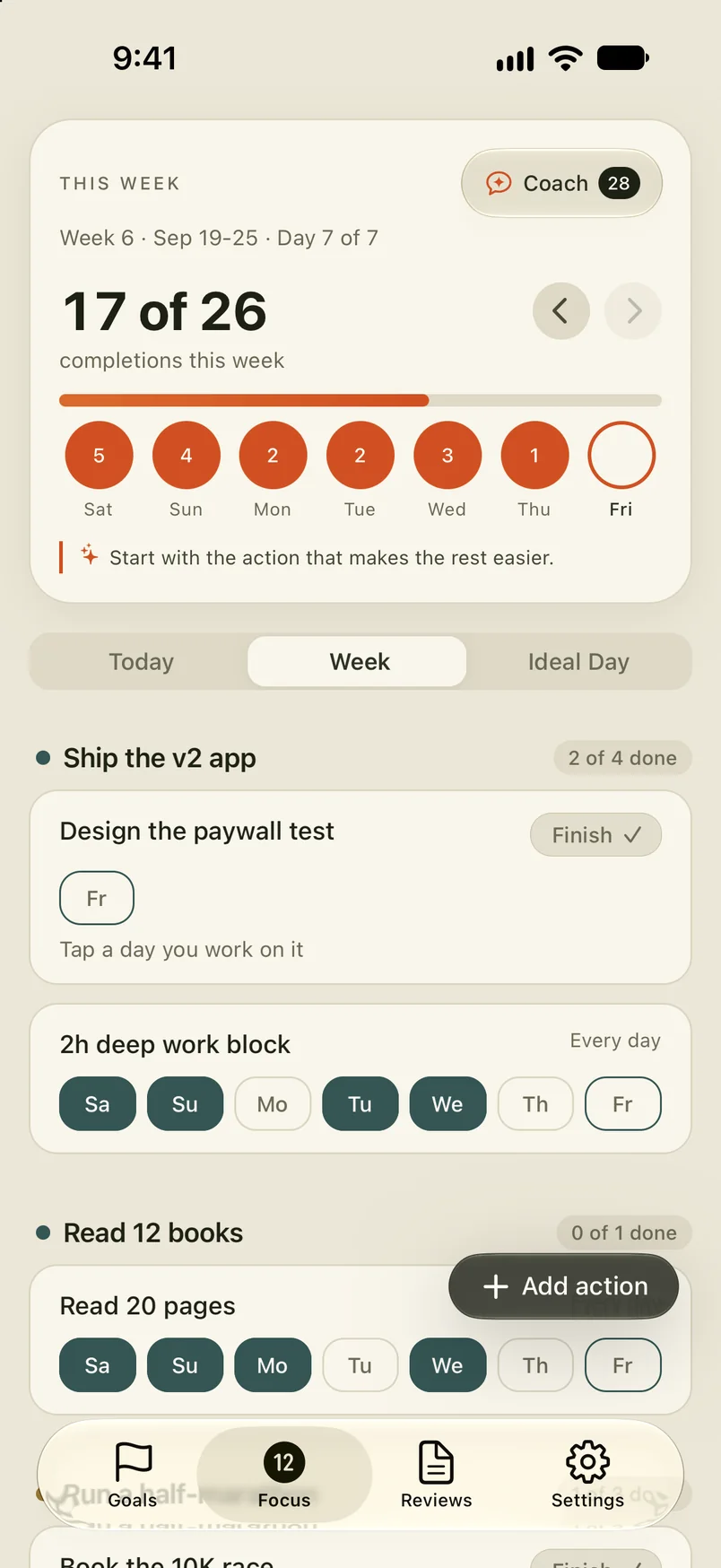
Plan this week only: three actions, each with a day, and a backup time for when the day breaks.
What if you have no time today?
Do the smallest version that still moves the goal. The all-or-nothing day goes like this: no time for the full run, so no run, and the evening ends with the feeling of having failed again. Ten minutes is not the plan, but it keeps the goal in the day.
Write the minimum version next to each action when you plan the week, so you don’t have to invent it on the bad day: 10 minutes instead of 25, one page instead of a chapter, one email instead of the whole list.
Does missing one day ruin a habit?
No. In a 12-week study of 96 people building a daily habit, Lally and colleagues (2010) found that missing one opportunity did not materially affect how the habit formed.
The risk is what the miss turns into. “I missed Thursday” becomes “I’ll restart on Monday”, and one day becomes a week. So resume at the next planned time, at the planned size: no double session to make up for it, and no new plan.
Does telling someone your goal help?
Telling someone how it went does. In a meta-analysis of 138 studies, Harkin and colleagues (2016) found that monitoring progress helped people reach their goals, and it helped more when the progress was reported to others or made public, and when it was written down.
You don’t need an audience. Tell one person what you plan this week, and tell them afterwards what happened, the misses included. Pick someone who will ask, not judge.
In 12Focus, that person can be a partner you choose. Both of you opt in, and a digest of your week goes out only after you finish your weekly review. Nothing is sent mid-week unless you choose to send it.
What do you do the day you want to quit?
Decide nothing big today. The day you want to quit is the worst day to judge a goal: you are tired, the misses are fresh, and the progress is hard to see. Three lines instead:
- Name what happened. One sentence, facts only: “Missed two runs, and work ran late all week.”
- Do the smallest version of today’s action. Ten minutes, one page, one email. Then stop.
- Decide at the weekly review, not today. Keep the goal, make next week lighter, or drop the goal on purpose, with the week’s real count in front of you. The 10-minute weekly review has the questions.
Fill it in here, then copy it into your notes. What you type stays in your browser.
Can an app help you stick to a goal?
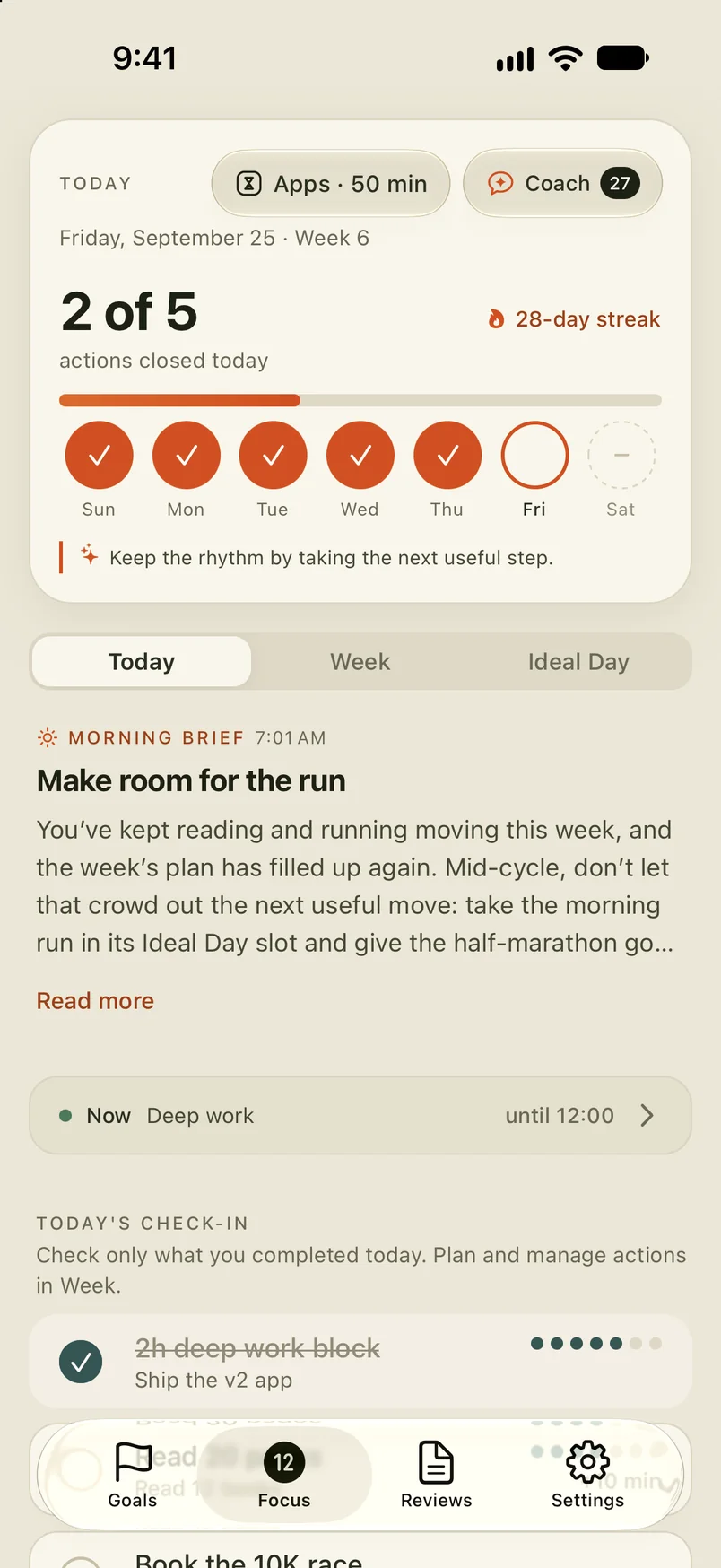
12Focus holds up to three goals for a 12-week cycle, turns each week into a few actions, and closes it with a short review, so the day after a miss starts from a plan instead of a blank page.
On iPhone and Android you can also give the apps that pull you away a daily allowance, and finishing a planned action adds minutes. How 12Focus helps you follow through.
What people ask when they want to give up
Why do I give up on my goals so easily?
Often it isn’t willpower. Common reasons: the finish line is too far away to shape this week, there is no next action with a day on it, a bad day turns into all or nothing, one missed day stretches into a week, or nobody else knows the goal exists. Sometimes the goal stopped fitting your life, and then dropping it on purpose is the right call.
How do I stop giving up on my goals?
Cut the goal to a 12-week piece, plan this week’s actions with a day for each, keep a minimum version for bad days, resume the day after a miss, and tell one person how the week went.
How do I stay consistent with my goals?
Decide in advance when and where each action happens, and keep a smaller version for the days that go wrong. In a meta-analysis of 94 independent tests, plans that spell out when, where and how to act had a medium-to-large effect on reaching goals (Gollwitzer and Sheeran, 2006).
Does missing one day ruin a habit?
No. In a 12-week study of 96 people building a daily habit, missing one opportunity did not materially affect habit formation (Lally and colleagues, 2010). Resume at the next planned time, at the planned size.
What should I do when I want to give up on a goal?
Name what happened in one sentence, do the smallest version of today’s action, and leave the big decision to your weekly review. Fill in the three lines on this page.
Is it ever right to quit a goal?
Yes. A goal that no longer matters is worth dropping on purpose. Make that call at the weekly review, with the week’s real count in front of you, not on the worst evening of the week.
Keep the goal. Make today smaller.
12Focus holds up to three goals for a 12-week cycle, turns each week into a few actions, and closes it with a short review.