 12Focus
Practical guide
How to build a 12-week goal plan you can actually follow
A useful plan does not promise a new life. It gives one important outcome a clear place in the next twelve weeks, then makes this week obvious.
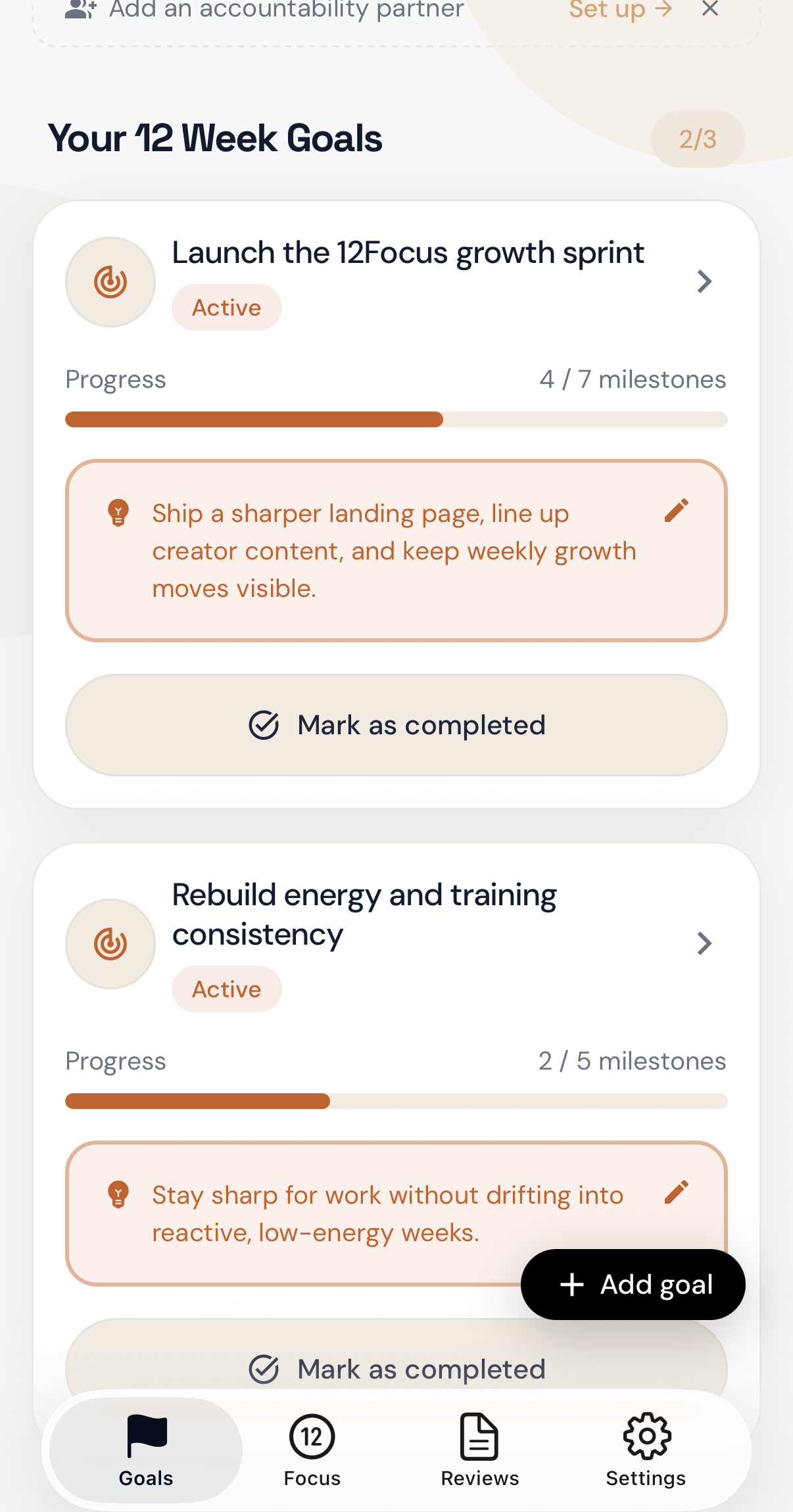
A 12-week plan only works when the next priority is still visible on an ordinary Tuesday.
1. Choose an outcome you can recognise
Write what “done” looks like before you choose the tasks
Start with one outcome that a reasonable person could verify at the end of the cycle. “Get healthier” is a direction; “complete twelve strength sessions and run a comfortable 5K” is something you can review honestly.
Specific goals are easier to plan because they force a decision about what counts. Keep the outcome challenging enough to matter, but within your influence. A plan cannot guarantee another person’s response, a promotion, or a viral post. It can define work you control.
- Outcome: What will be true by the end of week 12?
- Evidence: What will show that it happened?
- Boundary: What is deliberately not part of this cycle?
2. Plan for the obstacle, not the perfect week
Decide what you will do when the usual derailment appears
Most plans fail at a predictable moment: a late meeting, low energy, travel, or the impulse to open the distracting app “for a minute.” Name yours now. Then make an if–then response that is small enough to use.
Instead of
“I will work on my portfolio more.”
Write
“If it is 8:00 on Tuesday, then I will draft the first case-study outline for 30 minutes.”
Keep a fallback
“If Tuesday disappears, then I will protect 20 minutes at 9:00 on Wednesday and only write the opening.”
This kind of if–then planning has been studied as a way to turn an intention into a response to a specific cue. It is not magic, but it is more useful than relying on motivation alone. See the meta-analysis of implementation intentions and a later review of mental contrasting with if–then plans.
3. Give the cycle a shape
Use three phases instead of twelve identical weeks
A twelve-week plan feels less abstract when the weeks have different jobs. This is a simple planning frame, not a rule: adjust it to the work in front of you.
Weeks 1–3: Set the base
Remove uncertainty, create the first repeatable action, and make the next step easy to start.
Weeks 4–8: Do the visible work
Protect consistent work blocks and ship the part that creates real progress.
Weeks 9–12: Finish and learn
Close the gaps, make the outcome usable, and keep a record of what should change next cycle.
4. Make this week the unit of action
The one-page weekly planning template
Do this once a week. If you need a perfect system before you can start, the system is too heavy.
- This week moves the goal forward by: one concrete result.
- My three priorities are: the smallest meaningful actions that create that result.
- I will protect time on: specific days and times, not “when I have space.”
- The likely obstacle is: the thing that normally breaks this plan.
- If it happens, then I will: a smaller fallback action.
- At the end of the week, I will ask: what moved, what did not, and what changes next.
Example
Turn “build a portfolio” into a week you can see
Imagine the 12-week outcome is a portfolio with three finished case studies. The first phase is not “make a portfolio.” It is choosing the three projects, gathering the raw material, and publishing one simple outline.
In week one, the result might be: “Choose the three case studies and write the outline for the first.” The three priorities are: list candidate projects, choose three using one criterion, and draft the first outline. The protected time is Wednesday and Saturday morning. If Wednesday disappears, the fallback is a 20-minute outline on Thursday before checking messages.
That is enough. You do not need to map every day for twelve weeks. You need a direction for the cycle and a commitment you can keep this week.
When a week goes wrong
Do not restart the goal. Re-plan from the truth
Missed weeks are data, not proof that the goal was fake. At the weekly review, write what actually happened, identify the constraint, and choose the next smallest action. Reduce the plan before you abandon the direction.
- Keep the outcome if it still matters.
- Cut or delay the work that no longer fits the remaining time.
- Choose one restart action that takes less than an hour.
- Put the next review on the calendar before the week begins.
Sources and limits
A plan is a tool, not a promise
This guide is an original 12Focus planning framework. The research links support the specific idea of planning responses to obstacles; they do not prove that any app or timeframe will work for every person or goal.
Keep the next twelve weeks visible
12Focus gives the plan a home: goals, weekly priorities, a short review, and an iPhone-only boundary for distracting apps when you need one.