 12Focus
Goal tracking, without the illusion
Your tracker says you are making progress. Do you know what changed?
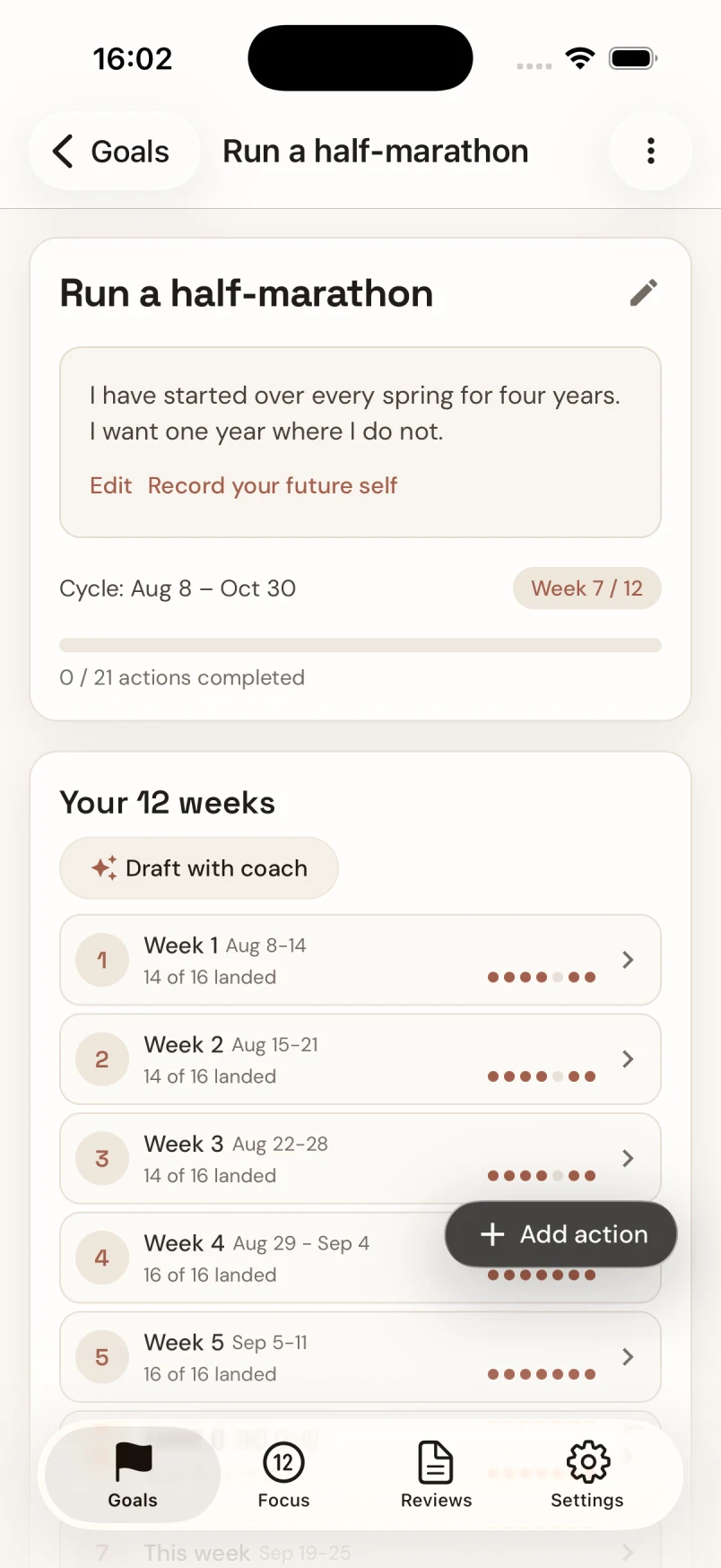
Tasks checked. Streak intact. Busy week survived. Yet the goal can feel exactly where it was. 12Focus is for the moment when a percentage is not enough: it connects what you did this week to the 12-week direction you actually care about — and helps you decide what changes next.
When tracking becomes theatre
Green ticks can hide a week that went nowhere
A percentage tells you how much you completed. It does not tell you whether you chose the work that mattered. You can finish six easy tasks, protect a streak, and still avoid the one uncomfortable action that would move the goal forward.
That is why a progress bar can feel strangely empty. It records activity, then asks you to invent the lesson yourself. Useful tracking does the opposite: it gives the week context, so you can see what you committed to, what actually happened, and where the plan lost contact with reality.
Busy work is easy to count
Completion counts reward what was finished, not necessarily what was brave, useful, or connected to the goal.
A streak cannot tell you what matters next
Consistency is valuable, but it cannot decide whether you should repeat the same approach or change it.
Data without reflection becomes decoration
If the record never changes next week’s choice, it is bookkeeping — not feedback.
Turn the record into a decision
A useful tracker should change next week’s plan
12Focus starts with a 12-week direction, then asks a simpler question: what deserves a place in this week? You choose a few concrete priorities while the goal is still visible. During the week, the next action is there to return to when urgent work tries to take over.
At the end of the week, you review the evidence: what moved, what slipped, and what made the plan harder than it looked. The goal is not to judge the week. The goal is to make the next one more honest. Over time, your history becomes a record of decisions and lessons — not a scrapbook of green ticks.
- Choose a few weekly priorities that belong to the larger direction.
- Keep the next action visible before the urgent list expands.
- Use the weekly review to name the real friction, not a prettier story.
- Carry one clear adjustment into the next week instead of starting over.
The 12-week advantage
Let the weeks tell you what the goal needs next
A twelve-month goal can make any week feel too small to matter. A 12-week cycle makes the connection harder to ignore. One unhelpful week is not a verdict, but three similar weeks are a useful signal: the plan may be too large, the action may be wrong, or the obstacle may need a different response.
That is the kind of progress worth tracking. Not “did I look productive?” but “what did this week teach me about getting this goal done?”
Goal tracking FAQ
Questions worth asking before you trust the number
What should a goal tracking app show?
A useful goal tracking app should show what you planned, what you actually did, what got in the way, and what to change next. A percentage alone cannot answer those questions.
Why is a weekly review useful for goal tracking?
A weekly review turns activity into a decision. It helps you see whether the week’s work moved the goal, name the friction honestly, and choose a more useful next step.
How does a 12-week goal help with tracking?
A 12-week horizon is short enough for each week to matter and long enough to notice patterns. It gives every weekly priority a clear direction.
Stop collecting proof you were busy
If your current tracker gives you numbers but not a better next move, try a system that keeps the goal in view, makes the week visible, and helps you adjust before another month disappears.